The most frequently offered advice from experts on my podcast?
Start small.
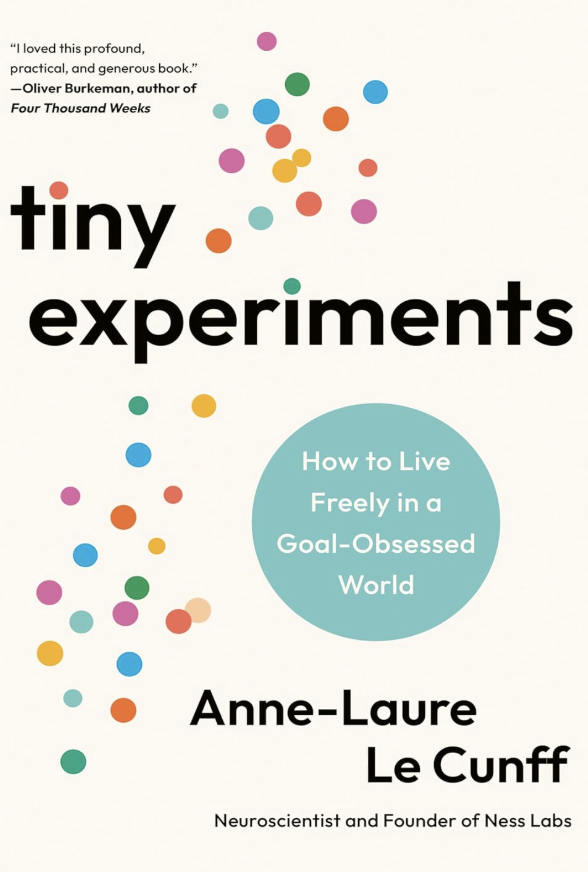
Anne Laure Le Cunff’s book offers a robust playbook on how to do that, bvacked by science.
In neuroscientist and former Google executive Anne-Laure Le Cunff challenges the linear goal-setting model that dominates modern life: pick the summit, map the path, execute. Drawing on her King’s College London research in psychology and neuroscience, she argues that linear goals assume we know what we’ll want years from now, an assumption the research doesn’t support. The antidote is the experimental mindset. Treat life as a laboratory. Run small, time-bound tests. Withhold judgment until the data is in.
Her advice on my podcast?
“Become the scientist of your own life.”
In our podcast conversation, Anne-Laure described an experimental mindset as combining high ambition and high curiosity, acknowledging that real growth requires both hard work and enough open doors for surprise and serendipity. She called retirement an amazing phase for experimentation, precisely because the routines and external structures that organized decades of life change overnight. That liminal space tends to trigger one of three automatic responses: cynicism, escapism, or perfectionism. Experimentation is the fourth and better option. It turns newfound uncertainty into newfound creativity.
Her core tool is the PACT, a commitment to curiosity. Pick an action, commit to performing it for a set duration, and collect the data before you judge. The structure starts with the word maybe: maybe if I did this, I’d meet new people. Maybe if I tried that, I’d feel more creative. Her example in our conversation fits retirement perfectly: reach out to one person whose work you admire on LinkedIn every Monday for six weeks. At the end, you assess. Did it grow your network? Did you meet interesting people? If yes, it may become a habit. If no, you learned something, which is its own form of success.
For people transitioning to retirement, Tiny Experiments reframes the central challenge. You don’t have to know what your next chapter looks like before you start living it. You need to run enough small, low-stakes experiments, in movement, wellness, learning, creative pursuits, connection, and service, to gather real data about what energizes you now. Habits, interests, and relationships get discovered, not declared. In this new phase where the old scripts no longer apply, becoming the scientist of your own life may just be the most impactful move of all.
Your former coleaguies will be envious of the new you.
____________________________
Listen to my podcast conversation with Anne Laure Le Cunff
More Best Books for Retirement
Listen to The Retirement Wisdom Podcast – and subscribe: Spotify | iHeartRadio | TuneIn | RSS | More