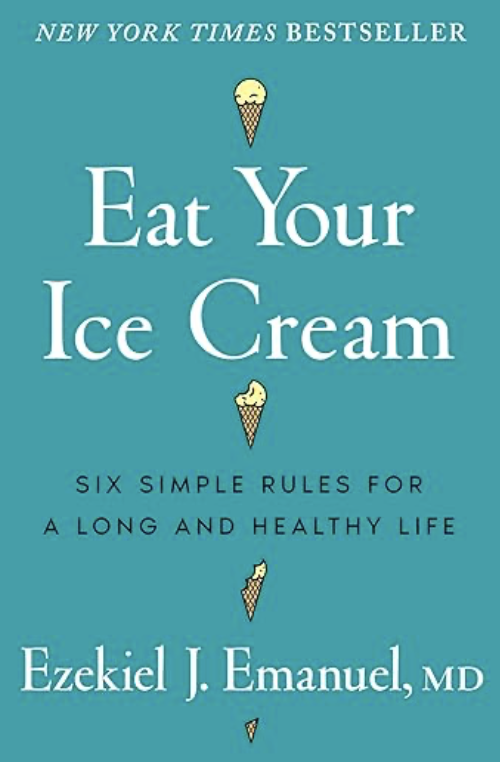
Ezekiel Emanuel’s Eat Your Ice Cream offers a refreshing antidote to the constant noise and excess of today’s wellness industry. Living well, he argues, does not require expensive supplements, punishing routines, or constant monitoring. It requires a handful of evidence-based practices, repeated consistently, the perspective to remember that health is a means to a good life, not the purpose of life itself.
Emanuel organizes the book around six memorable rules: avoid foolish risks; talk to people; expand your mind; eat sensibly without eliminating pleasure; move regularly; and get adequate sleep. The title captures his larger philosophy: wellness should include joy. If staying healthy feels like a second full-time job built on rigid discipline, deprivation and willpower, it won’t be enjoyable and it’s unlikely to last.
For people planning for retirement, this message is especially timely. Financial planning receives enormous attention, as it should, but money can’t compensate for poor health, diminished mobility, cognitive decline, or social isolation. Building wealth creates options; health gives us the capacity to fully explore them. The good news? Many factors shaping health are within our influence.
In our podcast conversation, Emanuel emphasized that social connection may matter even more than diet, exercise, and sleep. Strong relationships, and brief exchanges with what researchers call “weak ties,” (such as neighbors, baristas, or strangers) support health, happiness, and longevity. Leaving work can bring losses of structure, intellectual challenge, and a broad network of people we interact with regularly in the flow of the workday. Unless those benefits are replaced intentionally, forty hours of work can too easily become forty additional hours of television and other screens.
Emanuel offers Benjamin Franklin as a compelling alternative. A professor and Vice Provost at The University of Pennsylvania, Emanuel created a course on Franklin (who founded the university). He likes to say that Franklin “invented retirement for the working man.” Successful as a printer, Franklin retired at 42, yet much of what we remember him for came afterward. Retirement freed him up for decades of amazing inventions, lifelong learning, civic improvement, writing, and service. Even at 79, he was expanding his home to accommodate a library of approximately 4,000 books. He invented bifocals around that age and continued inventing into his eighties.
For Emanuel, Franklin’s accomplishments matter less than the qualities behind them: endless curiosity, sociability, openness to other people’s views, and commitment to personal improvement. Franklin listened, challenged his assumptions, tracked his habits and his progress, and kept trying to improve. He is an unusually relevant role model for retirement. Someone who didn’t withdraw from purposeful effort, but shifted toward new ways of learning, connecting, contributing, and growing, while clearly enjoying life.
There are a lot of practical takeaways from Eat Your Ice Cream and Emanuel’s observations on Franklin’s life. Ignore the noise on longevity hacks and short cuts. Instead, get back to the fundamentals. Volunteer, consider part-time work that reuses your skills and experience, learn something that challenges you, cultivate friendships, strengthen your muscles, and build a new schedule that keeps you engaged but not overwhelmed. The goal is not simply to accumulate more years. It is to develop the health, curiosity, relationships, and renewed purpose needed to make those years ones you’re fully living.
Eat Your Ice Cream: Six Simple Rules for a Long and Healthy Life
Listen to my podcast with Ezekiel Emanuel, MD, PhD