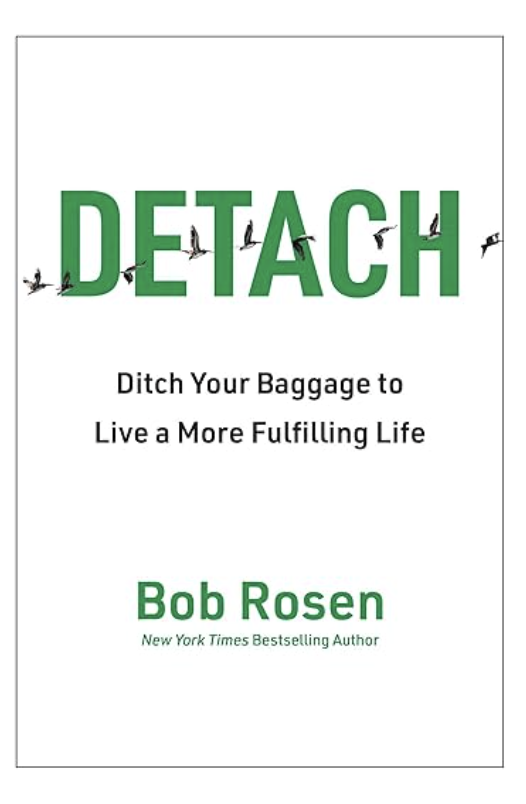
For many successful people, retirement brings a hard truth: it is not work they struggle to leave behind — it’s identity.
One of the greatest challenges my clients share with me is letting go. Indeed, letting go is hard to do.
That is the emotional terrain psychologist and leadership advisor Dr. Bob Rosen explores in Detach: Ditch Your Baggage to Live a More Fulfilling Life. Rosen argues that much of adult life becomes organized around accumulation: achievements, titles, status, routines, possessions, expectations, and carefully constructed self-images. Over time, these attachments can quietly harden into psychological baggage. The very habits that once fueled success begin limiting your growth.
The core insight is that fulfillment in later life depends less on what we acquire and more on what we are willing to release.
For people transitioning into retirement, this idea is spot on. Many retirees discover that beyond financial readiness lies emotional unreadiness. Your career provided structure, recognition, social connection, and a sense of usefulness. When that framework disappears, and the honeymoon phase fades, unresolved questions gradually emerge: Who am I without my role? What gives my life meaning now? What happens when achievement is no longer the organizing principle of my days?
One of the book’s most valuable ideas is the distinction between success and fulfillment. Many people spent decades optimizing for performance while unintentionally underinvesting in inner life, friendships, curiosity, play, creativity, reflection, or spiritual growth. Retirement creates an opportunity, sometimes uncomfortable, sometimes liberating, to confront what remains underneath.
Research in developmental psychology supports Rosen’s broader argument. Studies on successful aging increasingly show that well-being in later life is tied less to productivity and more to adaptability, emotional regulation, social connection, purpose, and openness to new identities. People who navigate retirement most successfully often demonstrate an ability to loosen rigid self-definitions and remain psychologically flexible as life changes. Rosen’s vision of detachment is about flexibility, the capacity to stop clinging to identities, fears, expectations, and narratives that no longer fit the next chapter of life. In this sense, retirement becomes less an ending and more like a beginning of a than a developmental phase of your life.
Practically, Rosen’s framework offers powerful questions to consider:
- What parts of my identity were built around external validation?
- What expectations do I need to release?
- Where has striving crowded out joy?
- What relationships, interests, or neglected parts of myself deserve more space now?
- What would it look like to design a life around meaning rather than achievement?
Perhaps the book’s deepest contribution is reframing retirement itself. Rather than viewing retirement as withdrawal from relevance, Rosen suggests it can become a rare opportunity for reinvention, a transition from performance-driven living toward a more intentional and internally directed life.
For people entering this transition stage, Detach offers an important reminder: the next chapter of life is not created simply by stopping work. It is created by learning what to carry forward, and what to finally let go. So, ditch what no longer serves you. It might just be what’s holding you back from the retirement you deserve.
_________________________
Listen to my podcast conversation with Dr. Bob Rosen
Detach: Ditch Your Baggage to Live a More Fulfilling Life
Explore the conversations of The Retirement Wisdom Podcast