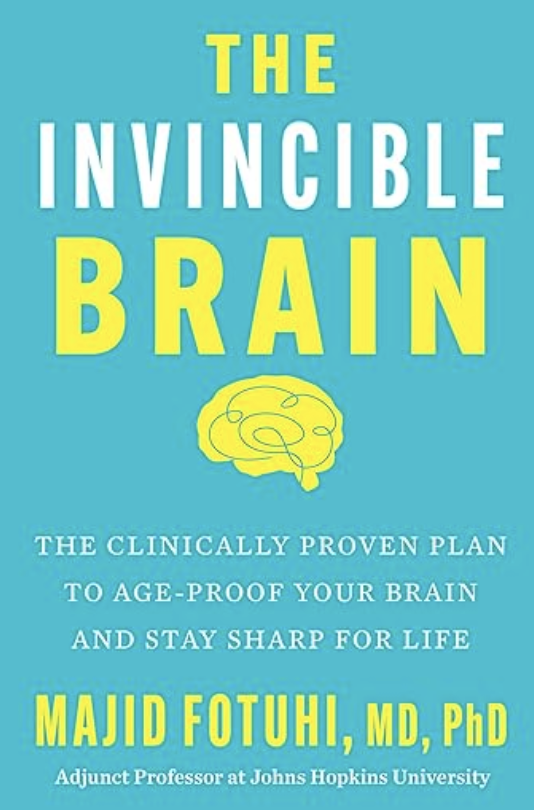
In The Invincible Brain, Majid Fotuhi delivers a provocative and optimistic argument: cognitive decline is not an unavoidable consequence of aging. Drawing on neuroscience, clinical evidence, and years of treating patients with memory disorders, the Johns Hopkins neuroscientist contends that the brain remains capable of growth, repair, and adaptation well into our seventies, eighties, and beyond. For retirees, the book reads less like a warning about dementia and more like a blueprint for cognitive renewal.
At the center of Fotuhi’s framework is the hippocampus — the brain’s memory hub. In our conversation on The Retirement Wisdom Podcast, he explained:
“Cognitive decline with aging is not inevitable.”
That statement anchors the book’s central thesis. Fotuhi argues that the brain behaves much like a muscle: it strengthens when challenged and weakens when neglected. His clinically tested 12-week program is organized around five pillars of brain health: exercise, sleep, heart-healthy nutrition, stress reduction, and continuous learning.
The most compelling message for retirees is his rejection of the traditional “slow down and relax” model of retirement. Fotuhi warns that passive retirement, with excessive television, isolation, inactivity, and a lack of challenge, accelerates cognitive decline. Instead, he advocates for an “engaged retirement”: learning languages, dancing, playing music, volunteering, building relationships, and staying physically active.
In one moment, that stuck with me, Fotuhi said:
“I view retirement as a new childhood.”
It’s a compelling reframe. Retirement, in his view, is not a withdrawal from life, but an invitation to return to curiosity, experimentation, and growth.
It’s about attention to the fundamentals. The things your grandparents told you about. Exercise is the natural equivalent of a wonder drug. Fotuhi cites evidence that walking 10,000 steps daily may reduce Alzheimer’s risk by as much as 50 percent. Sleep, often short-changed during our working years, is the brain’s nightly cleaning and repair cycle. Chronic stress is toxic to memory systems, while learning new skills helps build “cognitive reserve,” the brain’s resilience against disease and aging.
The book’s most powerful insight is this: your brain is not a fixed asset. It’s a living system constantly responding to how you live, and the choices you make day-to-day. We can choose a brain-friendly life in retirement. So, ditch the question How do I avoid decline?” Choose instead “How do I continue growing?”
Listen to my podcast conversation with Majid Fotuhi, MD , PhD
Explore the conversations of The Retirement Wisdom Podcast